Openings · A02–A03

Bird's Opening

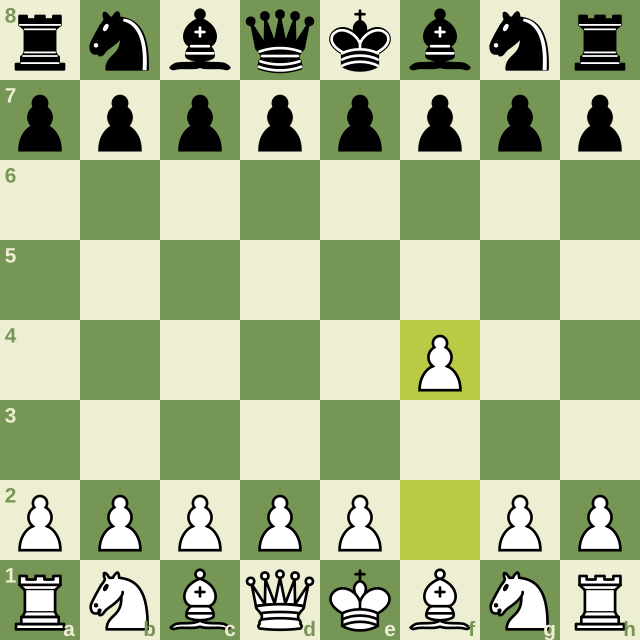
1.f4 — a Dutch Defence with an extra move, and the loosest first move that is still respectable.

1.f4played as White

Play it through on the board below, and 8 moves into the main line.

Practise the line

You play White; the other side answers on its own. Nothing here is saved or graded. The line runs on past the moves that define the opening and into the main line, because two moves is not a drill.

8
7
6
5
4
3
2
a1
b
c
d
e
f
g
h
Your move 1 of 50/5
  1. 1.f4d5
  2. 2.Nf3Nf6
  3. 3.e3g6
  4. 4.b3Bg7
  5. 5.Bb2

Your move. Drag a piece, or tap it and then its square.

The idea

The pawn on f4 takes e5 away and points at the kingside. White follows with Nf3, e3, b3 and Bb2, castles, and plays for the e5 square and a slow attack down the half-open f-file.

The cost is paid at once: the e1–h4 diagonal is open, and the king's cover has a hole in it before either side has developed a piece. Most of what goes wrong for White in this opening goes wrong on that diagonal.

Common mistakes

Three that come up again and again below master level: named traps and the errors every coach corrects.

Walking into From's Gambit

After 5…Qxg3+
  1. 1.
  2. 2.
  3. 3.
  4. 4.
  5. 5.
The mistake
Taking both pawns and then developing with 4.Nc3, as if the position were an ordinary one.
Why it costs
It is mate in two more moves: 5…Qxg3+ 6.hxg3 Bxg3 is checkmate, because the f-pawn has gone and f2 is the only flight square the king has. Every piece White owns is still on the back rank.
Instead
4.Nf3, which takes h4 from the queen, followed by g3 and Bg2. A pawn up in a sharp position is a fine outcome; walking down the diagonal you opened on move one is not.

Building the Stonewall the wrong way round

After 6…c5
  1. 1.
  2. 2.
  3. 3.
  4. 4.
  5. 5.
  6. 6.
The mistake
Playing d4, e3 and c3 behind the f-pawn without asking where the queen's bishop is going.
Why it costs
That is a Stonewall with the bad bishop still inside the wall. The pawns on c3, d4, e3 and f4 leave the bishop on c1 with a single diagonal and nothing on it, while Black plays …Bf5 or …Bg4 and …Ne4 with the better version of the same structure.
Instead
b3 and Bb2 before the chain is built, so the bishop is outside it. Bird players who like the Stonewall play the bishop first, every time.

Forcing e4 against 1…d5

After 5…Qxd1+
  1. 1.
  2. 2.
  3. 3.
  4. 4.
  5. 5.
The mistake
Breaking with e4 to get a pawn to e5, when Black has already put a pawn on d5.
Why it costs
…dxe4 and the queen trade on d1 leave White with the king in the middle of an open board, no castling and no attack, in exchange for a square that was a long-term plan rather than a move-six break.
Instead
b3, Bb2, Be2 and O-O. The e-pawn advances when the answer to it is not an exchange of queens.

In real games between beginners

  • 1 in 140games end with White giving checkmate by move 15. In all openings: 1 in 33.
  • 1 in 39games end with White getting checkmated by move 15. In all openings: 1 in 54.

From 3,695 Lichess games in this opening between players rated under 1200, blitz and slower, September 2026. How we counted.

What the engine says

After 1.f4, these are Black's six best moves according to Stockfish, with the bar showing Black's chance of winning. The whole list sits within 3 percentage points of win chance: none of them is a mistake, and the choice is about the positions you want to play.

  1. d5-0.3
  2. Nf6-0.3
  3. e6-0.2
  4. g6-0.1
  5. Nh6+0.0
  6. Nc6+0.0

The engine's main line from d5: d5 Nf3 c5 e3 g6 Bb5+ Bd7 Bxd7+.

Stockfish 18, depth 24. Scores are in pawns from White's side. Another engine or depth will move individual numbers a little; the picture does not change. How we check.