Openings · D30–D69

Queen's Gambit Declined

Hold the centre with a pawn and accept a cramped game: the most reliable answer to 1.d4 there is.

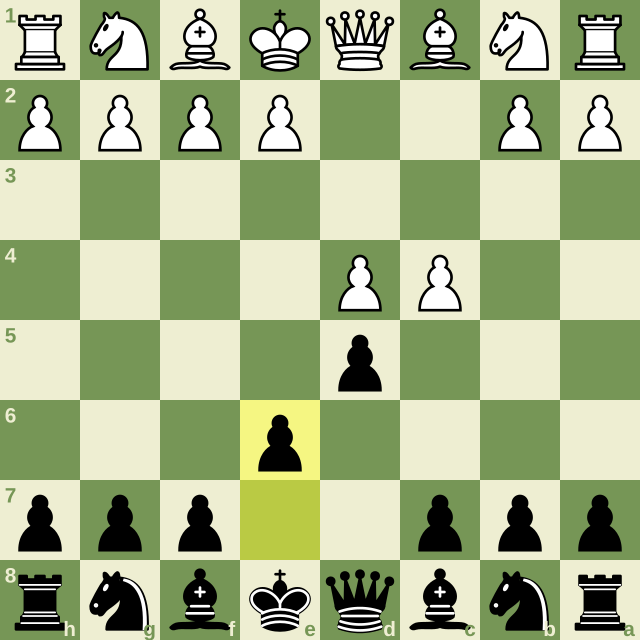
1.d4 d5 2.c4 e6played as Black

Play it through on the board below.

Practise the line

You play Black; the other side answers on its own. Nothing here is saved or graded.

1
2
3
4
5
6
7
h8
g
f
e
d
c
b
a
Your move 1 of 20/2
  1. 1.d4d5
  2. 2.c4e6

White is answering…

The idea

2…e6 declines the gambit and defends d5 with a pawn, which is the soundest way to do it. Black is solid, slightly cramped, and rarely in danger of anything sudden.

The game is about two things: getting the c8 bishop out from behind the pawn on e6, and finding the moment for …c5 or …dxc4 followed by …c5. Everything else is preparation for one of those.

Common mistakes

Three that come up again and again below master level: named traps and the errors every coach corrects.

The bishop that never comes out

After 6…Nbd7
  1. 1.
  2. 2.
  3. 3.
  4. 4.
  5. 5.
  6. 6.
The mistake
Completing development in name only, with the bishop on c8 still behind its pawn.
Why it costs
It is the same complaint the French has, and it is the whole difficulty of the opening. A QGD where Black never solves it is a QGD Black spends forty moves defending.
Instead
Choose a plan: …b6 and …Bb7, the knight tour …Nf8–g6 with …Bd7, or the freeing …dxc4 and …c5 when the position allows.

The Elephant Trap, from the other side

After 7…Bb4+
  1. 1.
  2. 2.
  3. 3.
  4. 4.
  5. 5.
  6. 6.
  7. 7.
The mistake
Believing the pin, and avoiding …Nbd7 because it seems to hang the d5 pawn.
Why it costs
It does not hang. If White takes, 6…Nxd5 7.Bxd8 Bb4+ 8.Qd2 Bxd2+ 9.Kxd2 Kxd8 wins a piece. Knowing the trap is what lets you play the natural move.
Instead
Play …Nbd7 and let White decide whether to walk into it. This is one of the few pieces of opening theory that pays for itself in a single game.

Taking on c4 too early

After 4…dxc4
  1. 1.
  2. 2.
  3. 3.
  4. 4.
The mistake
Giving up the centre with …dxc4 before …c5 is ready to follow.
Why it costs
The pawn cannot be kept, so the exchange is not about winning it — it is about getting …c5 in with a tempo on the bishop that recaptures. Played too early, it simply hands White the centre and a free developing move.
Instead
Wait for Bd3, so that …dxc4 hits the bishop and …c5 comes with the time you have gained.

In real games between beginners

  • 1 in 140games end with Black giving checkmate by move 15. In all openings: 1 in 54.
  • 1 in 81games end with Black getting checkmated by move 15. In all openings: 1 in 33.

From 2,014 Lichess games in this opening between players rated under 1200, blitz and slower, September 2026. How we counted.

What the engine says

After 1.d4 d5 2.c4 e6, these are White's six best moves according to Stockfish, with the bar showing White's chance of winning. The whole list sits within 3 percentage points of win chance: none of them is a mistake, and the choice is about the positions you want to play.

  1. Nf3+0.4
  2. Nc3+0.3
  3. cxd5+0.2
  4. e3+0.2
  5. a3+0.1
  6. Qc2+0.1

The engine's main line from Nf3: Nf3 Nf6 g3 dxc4 Bg2 Bb4+ Bd2 a5.

Stockfish 18, depth 24. Scores are in pawns from White's side. Another engine or depth will move individual numbers a little; the picture does not change. How we check.

Where it fits

The Queen's Gambit Declined is a variation of the Queen's Gambit, whose page covers the ideas this one takes for granted.