Openings · C20

Wayward Queen Attack

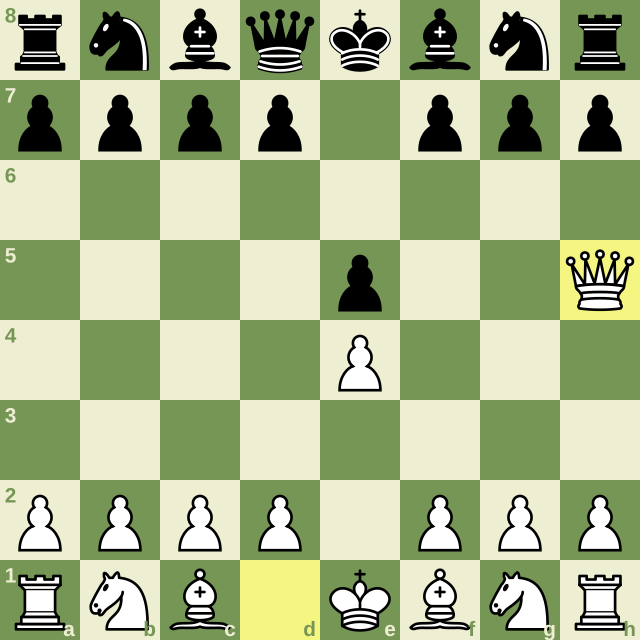
The queen comes out on move two to aim at f7: the start of Scholar's Mate, and the first trap almost every new player meets.

1.e4 e5 2.Qh5played as White

Play it through on the board below, and 5 moves into the main line.

Practise the line

You play White; the other side answers on its own. Nothing here is saved or graded. The line runs on past the moves that define the opening and into the main line, because two moves is not a drill.

8
7
6
5
4
3
2
a1
b
c
d
e
f
g
h
Your move 1 of 40/4
  1. 1.e4e5
  2. 2.Qh5Nc6
  3. 3.Bc4g6
  4. 4.Qf3Nf6

Your move. Drag a piece, or tap it and then its square.

The idea

2.Qh5 attacks the pawn on e5 and, with a bishop on c4 to follow, the pawn on f7, which only the king defends. If Black does not see it, Qxf7 is checkmate on move four. That is the whole plan, and against players who have not met it, it works astonishingly often.

Against a player who has, it achieves little. The queen is out early, where Black's pieces can chase her while developing. Black's best answer is simply to defend e5 with 2…Nc6, block the diagonal with …g6 when the bishop arrives, and then develop with gain of time. Knowing that sequence is the point of this page, whichever side you play.

Common mistakes

Three that come up again and again below master level: named traps and the errors every coach corrects.

Scholar's Mate

After 4.Qxf7#
  1. 1.
  2. 2.
  3. 3.
  4. 4.
The mistake
Black develops the knight to f6 to attack the queen, without noticing what the queen and bishop are both aiming at.
Why it costs
f7 is defended only by the king, and the queen takes it with the bishop behind her. The king cannot recapture, and it is checkmate on move four.
Instead
3…g6 shuts the queen's diagonal to f7. After 4.Qf3, renewing the threat, 4…Nf6 defends f7 and develops at the same time.

Pushing g6 a move too soon

After 4.Qxh8
  1. 1.
  2. 2.
  3. 3.
  4. 4.
The mistake
2…g6 kicks the queen before e5 is defended.
Why it costs
3.Qxe5+ takes the pawn with check and, with the g-pawn gone from g7, the queen now looks straight down the long diagonal at the rook on h8. Black blocks the check and loses the rook.
Instead
Defend e5 first with 2…Nc6. Only then does …g6 cost nothing.

Taking a defended pawn

After 3…Nxe5
  1. 1.
  2. 2.
  3. 3.
The mistake
White grabs the pawn on e5 out of habit after 2…Nc6.
Why it costs
The knight on c6 now defends e5, so the queen is simply lost for a pawn. Before any capture, ask whether the piece is protected.
Instead
3.Bc4, carrying on with the plan, or 3.Nf3 and ordinary development. The queen should not move again unless she has to.

Essential for beginners

  • 1 in 12games end with White giving checkmate by move 15. In all openings: 1 in 33.Quick wins
  • 1 in 48games end with White getting checkmated by move 15. In all openings: 1 in 54.

From 11,394 Lichess games in this opening between players rated under 1200, blitz and slower, September 2026. How we counted.

Questions

Is the Wayward Queen Attack a good opening?

Against beginners it wins a lot of quick games, which is why it is played so often at low ratings. Against correct defence White has developed one piece badly, and the queen will lose time being chased. Learn it to defend against it before you play it.

How do you stop Scholar's Mate?

Defend e5 with 2…Nc6, and when the bishop comes to c4, block the diagonal with …g6. If the queen moves to f3 to aim at f7 again, …Nf6 defends it. Then develop and chase the queen.