Chess rules
What happens when a pawn reaches the end?
A pawn that reaches the far end of the board must be swapped for a queen, rook, bishop or knight of the same colour, as part of the same move. You choose, and you can have more than one queen.
The rule
- 1A pawn that reaches the last rank must be promoted, straight away, as part of that move.
- 2You choose a queen, rook, bishop or knight. It cannot stay a pawn and cannot become a king.
- 3The choice does not depend on which pieces were captured: you can have two or more queens.
- 4The new piece acts at once, so a promotion can give check.
See it on the board
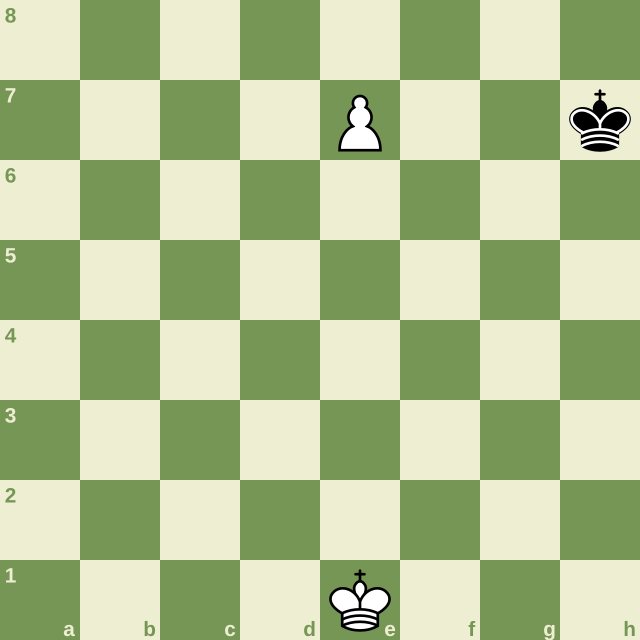
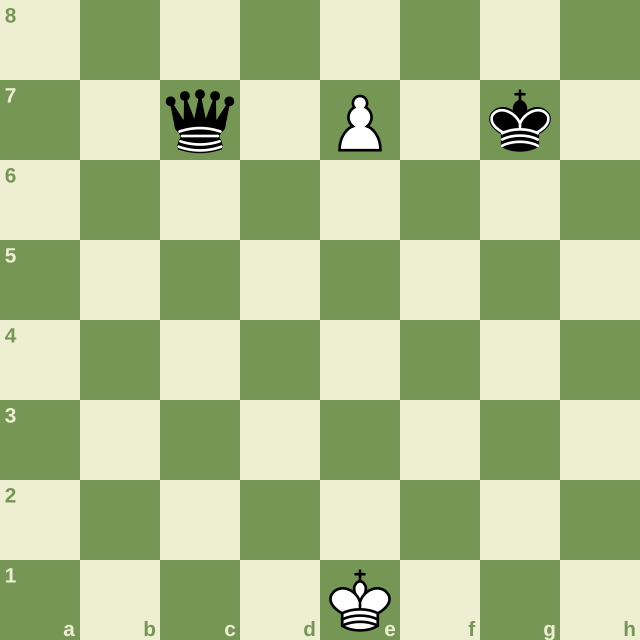
Questions
Can I have two queens?
Yes. Promotion does not depend on what has been captured, so you can promote to a second queen, or a third.
Can you choose not to promote, or keep it as a pawn?
No. A pawn that reaches the last rank must become a queen, rook, bishop or knight in the same move. A move to the last rank without choosing a piece is not a legal move.
What happens if the king reaches the other side?
Nothing. Only pawns promote. A king, queen, rook, bishop or knight on the far rank is simply a piece standing there.
Why would anyone choose a knight?
Because the knight moves in a way the queen does not. If promoting to a knight gives check and attacks something at the same time, it can be the strongest choice.
Next step
Lesson · 6 minFinish with a queen or a rookYou have a new queen. Here is how to finish the game with it.Source: FIDE Laws of Chess (effective 1 January 2023), Articles 3.7.3.3 to 3.7.3.5. Every diagram on this page is checked against the rules by code: how we check.